

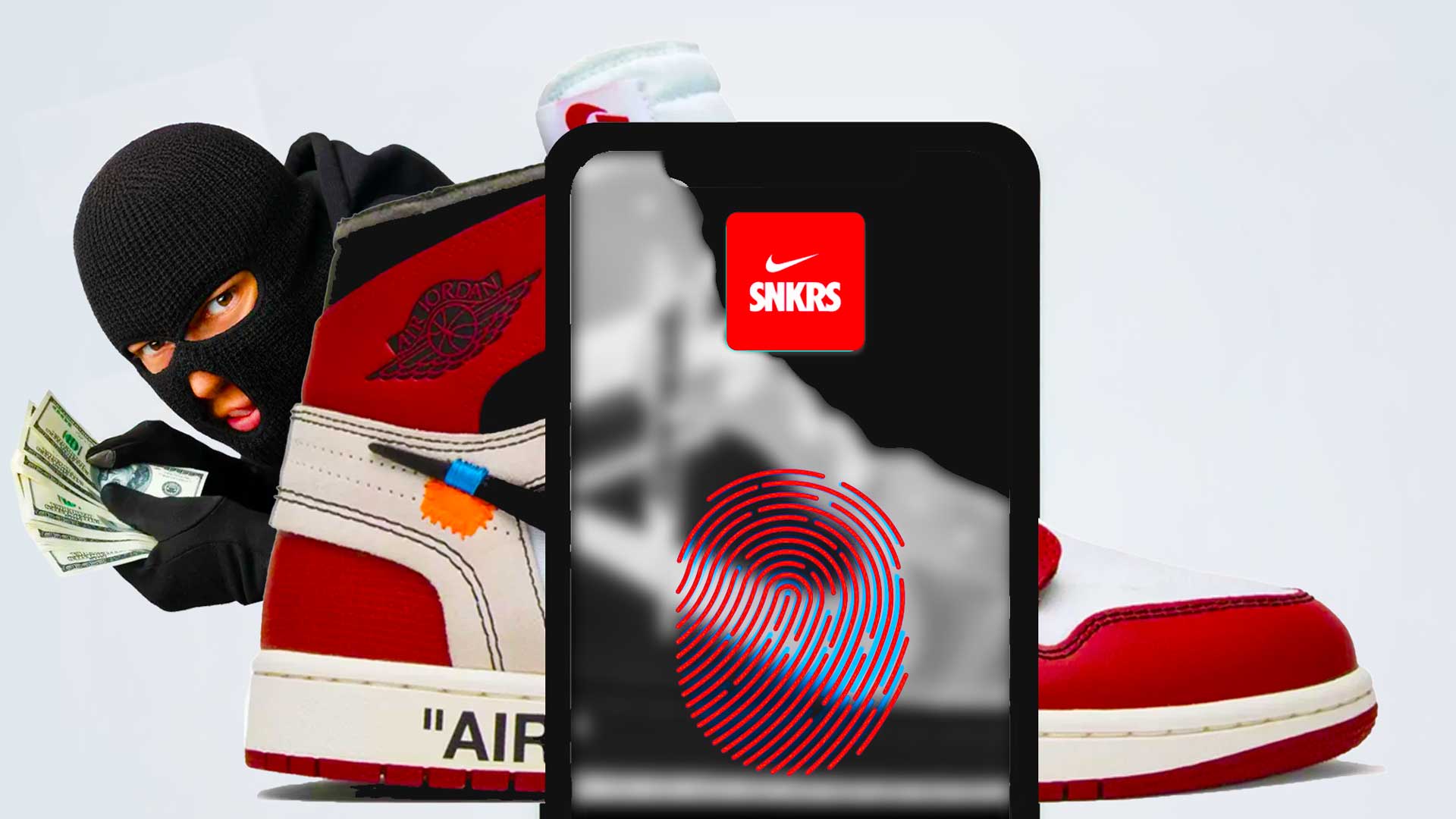


According to reports on social media, Nike just filed a patent for a Digital Authentication System that could change how to tell if a sneaker is fake or real. The new tech is meant to shake up the resale market and ensure sneakerheads that they have the authentic product in their hands. But this isn’t just another tag you peel off or a QR code on the shoe. It’s actually an invisible fingerprint that can only be detected by an official Nike app. And it’s going to change everything!
The patent surfaced through a long breakdown by Sneaker Legal, a lawyer who focuses on sneaker-related patents. The filing covers footwear and apparel and outlines a digital authentication system that embeds machine-readable identifiers directly into the product. The patent also describes visually imperceptible patterns, conductive inks, magnetic materials, and encoded grayscale color grids built straight into the shoe. A phone camera or specialized scanner can read it, but our eyes can’t. It’s like invisible ink.
See the diagrams below:
But that’s not all. The patent also outlines hidden zones within the midsole, each containing magnetic material with specific strength and flux density. Miss one tiny detail and the product fails authentication. So you can’t trick anyone with a good pair of reps anymore.
In fact, in order to counterfeit this system, a replica factory would need to match microcoding patterns, electrical resistance values, and magnetic signatures across multiple zones on the shoe. That’s not impossible forever, but it’s not something a typical rep operation pulls off quickly. And it’s a lot of effort. One Instagram user summed it up neatly: “That might help for a couple of years until the rep manufacturers catch up.” But it won’t be soon.
The reactions online are very mixed, with some for it and others against it. “I’m sorry, so now our clothes will be able to track where we go??” one commenter asked on Instagram. Another took a calmer view: “As long as it’s not tracking user locations, I guess it’s fine. Not sure what unlock resale means? Like, I can’t resell items for a certain time period?” Nike’s patent focuses on product data, not location tracking, tying authentication to serial numbers, factory locations, materials, manufacturing batches, and ownership state. It’s honestly the best way to stop fakes.

But yes, that ownership detail raises eyebrows for many people. While some are concerned about Nike using the system to track individuals, it’s actually only meant to give Nike visibility across its supply chain. It’s meant to address backdooring and large-scale theft, problems Nike has faced repeatedly in recent years. If a stolen pair shows up, the fingerprint lets you and them know immediately.
It also puts pressure on resale platforms, too. Buyers would no longer need third-party authentication that sometimes misses. You won’t need to have your shoe’s sole sound like a watermelon vs a coconut anymore. A quick scan could confirm authenticity and whether or not you’ve been duped. One user nailed the appeal: “It’s just going to be something to scan like a QR code that gives the details of the shoe!! Game changer, I might start buying resale with this. I don’t trust anyone if I don’t hit on release day I don’t get the shoe.. and I have a lot of shoes!!”
Nike hasn’t announced when or if this system will go public. Another commenter guessed it would appear on specific drops first, not every release. That sounds realistic. Rolling this out across all products would take time, money, and patience.
What’s clear is that Nike is thinking beyond basic anti-counterfeit tech. This patent doesn’t just aim to spot fakes. It quietly tightens control over production, movement, and resale. Whether that feels reassuring or unsettling depends on which side of the sneaker world you live on.
Hear more about the new Nike digital authentication system from YouTuber Elliot Page.
RELATED: 23 Little-Known Air Jordan Facts That Changed Sneaker Culture